Writing Around Manhattan

Five full days in New York City offer a multitude.

Of people.

Of experiences.

Of observation.

Each and all, an overload of every sense. In other words, nirvana for a writer.

DH and I traveled to Manhattan to explore our passions at both Book Expo and the Audio Publishers Association Conference.

I’m the author in our tribe, writing both fiction and nonfiction. He’s pursuing audio narration, a perfect sequel to his radio news days.

Standing among the thousands at these conferences, we both remembered our past. Where we met and how we lived, several lifetimes ago.

But what we learned last week is that, because of our pasts, anything is possible in the future, even if we’re both overwhelmed.
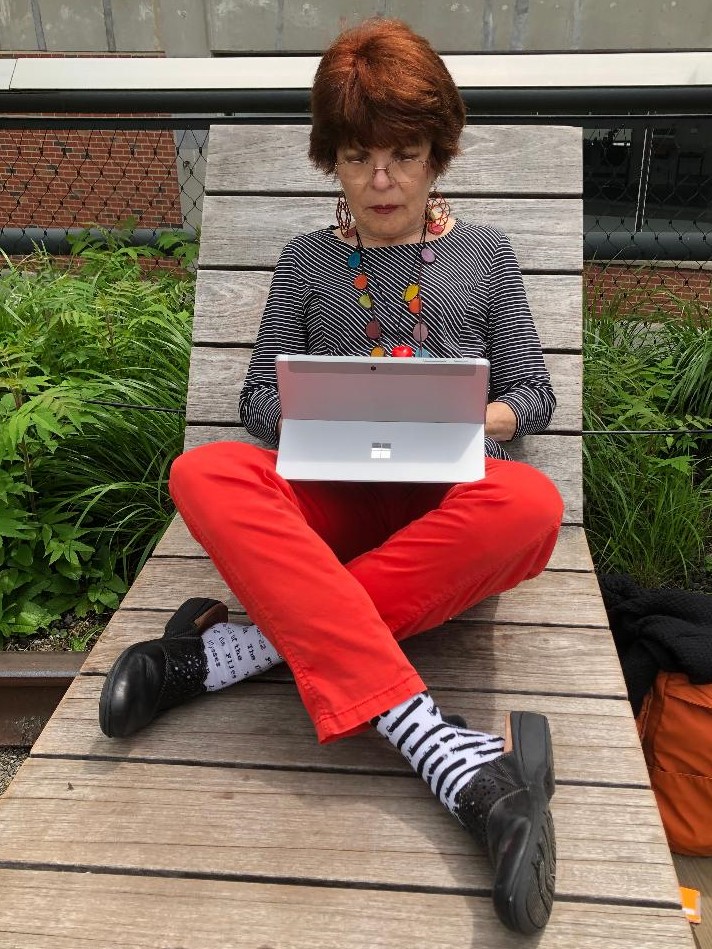
Writing every day offered a balm, a centering point. My computer called me back to the page.

It sounded like a voice whispering me to capture what I’d learned, heard, seen, discovered in panel discussions, even casual conversations. During a round-trip trek of the High Line, I pulled over to take dictation.

Yes, sometimes writing only involves dictation.

Later, breakfast at Cafe Lalo beckoned. This Upper West Side restaurant remains a must-stop any time New York calls either DH or me.

Its brick walls and glass-walled front offer a bohemian decor that enriches the creative food it so playfully delivers.

Go at night and you’ll recognize its interior from the movie, You’ve Got Mail, 20+ years ago. Nothing is heaven like Lalo chocolates and hot tea on a cold New York night.

By the way, that orange cup — for green tea, of course — was this year’s unexpected treat. I’d have bought one but they won’t sell their china.

Finally, a first-time visit to Central Park’s Strawberry Fields demanded one last round of daily writing. But this became a prayer for peace.

It felt so vital following the cacophony of unexpected crowds a hillside away.

I fled the Imagine memorial, diminished. I imagined John Lennon would feel the same. 

Musicians performing despite signs forbidding it. Vendors selling bad reproductions and cheap art. People plopping down for pictures, one pair of butt cheeks slapping in after another.

Yes, it was that crude. I ran away to write it down, get the unpleasantness, the disappointment out of my head.

DH showed me his photo much later. I saw not me, but a writer at work. I imagined an unwitting Monet model, consumed not by the artist at work but by the art itself.

Maybe that’s what Mr. Lennon was after, too.

Bedtime with My Cousin Vinny, Version 2.0

NOTE: Ghost fingers posted a rough draft of this blog post last night. It’s been replaced with this final version. Enjoy! 

Vincent Van Gogh always seemed a nut case.

You don’t chop off an ear if you’re sane.

But I met the artist this week—via his letters, etchings, sketches, and paintings—and realized he’s my long-lost cousin. What else do you call someone with whom you share three great loves: books, shoes, and colors?

My personal trifecta grants Mr. Van Gogh an irreverent nickname: Vinny.

Isn’t that the gift we give family members?

Coincidence that the moniker matches Joe Pesci’s 1992 movie, My Cousin Vinny. 

All this discovery unfolded at Houston’s Museum of Fine Arts (MFAH) and its fantabulous exhibit titled Vincent Van Gogh: His Life in Art. This one-city show runs through June 27th; attending is beyond worth-your-time. From Houston, the exhibit returns to its Amsterdam home.

Since childhood, I’ve visited countless museums and art galleries. All around the globe. This show was different.The day became profound. Art, when married with words, can do that.

My skin actually t‑r-e-m-b-l-e‑d when I viewed Vinny’s work. A first.

Around me, I heard tears and sniffles. Another first.

The floor-to-nearly-ceiling sketches stopped me in my shoes.

This image was drawn in the late 1800s. My mind struggled with its how-to. As in: how do you create something this large—on your hands and knees? Where do you find, in 1888, paper this big? How do you store it?

Questions raced through my mind. Then I saw the clogs.

I gasped. Something about the yellow background and the plain pair of shoes screamed strength, confidence, and power.

How could that be?

Vinny’s strong brushstrokes—around, over, and through the tightly-shaped shoes—transformed the leather into something more than a simple something you walk in.

Art critics disagree on Vinny’s intent with A Pair of Leather Clogs. They cite specific walks, spiritual wanderings, or life paths.

How much more RoadBroad can you get?

Perhaps Cousin Vinny was a RoadDude. He did live all over Europe.

In these clogs, I saw myself. These weren’t, after all, ordinary shoes. They were clogs, the only type of shoe I paint. See my February 18th post to refresh the hobby details.

No way am I suggesting that I reside in Mr. Van Gogh’s league. Instead, I believe there’s an artistic universality in painting shoes.

Call it magic juju. His painting offers a question, a reflecting point, ahead of any journey. The shoes beg you to ask, in advance: are you ready? 

But how often do we consciously ask? Do we save the preparation for the bigger roads only? How about in the middle of the journey—do we consider our observations? After we leave the road, do we look back to ask: what did I learn? 

Creation resides with the artist. Interpretation belongs to the observer. What freedom, for both!

Shoes, regardless of who paints — or walks in — them, offer preparation, experience, or wisdom. We choose our takeaway(s).

The exhibit ends with a delight-filled interactive play area.

When I spied Van Gogh’s Bedroom at Arles, I had to get between the sheets.

Cousin Vinny called me. Or, maybe, I’m half-crazy after all.

When the Road Offers Memories & Change

March’s road trip to Austin offered a two-fer.

Celebrate author-friend, Dorothy Van Soest, at her latest book reading.

Swing by the University of Texas campus and cruise around on grounds where I once stomped.

I stop mid-plan.

When, precisely, did I attend UT-Austin? When did I leave?

My mind races back to graduation, spring of 1979.

I dig out my college diploma. Discovery yields an oh-my-god. 

I graduated from college 40 years ago.

Today.

What are the odds? 

And…40 years? How did that happen?

The new-graduate photo at right offers a trio of chuckles: an Instamatic photo enlarged to pixilating — beyond the limits of this ancient technology; Farrah Fawcett wannabe-hair; and pair of ghastly raccoon eyes.

More questions: what was I thinking? Why, UT-Austin, was my tassel red and not orange?

DH marveled at my pre-DW look, worn so proudly a decade before we married. He marveled, too, at the UT campus, amused at how little I recognized.

My sense of loss-and-big-change began at the communications building, my life center for three years.

Dull brown now covered the building known as the Rusty Bucket. Framed in weathered steel, the building’s exterior had morphed during our college years into a distinctive orange-brown hue. So, we renamed the building. It stuck. What do they call it now?

New also is the building across the street: a stand-alone home for UT radio with twice as many stations as in my day.

I began my radio career here, at KUT. But our studios sat deep in the bowels of the Rusty Bucket, an afterthought.

My chest puffs up. In today’s era of social media dominance, it’s a new point of pride that my alma mater supports radio like this. Even the pedestrian street-bridge reeks of extra resources, even special privilege. 

If faster access results in better news and information, bring it on, kids!

Down the street, I spot The Co-Op, where we bought our textbooks. Nowadays, turntables appear to headline the sales.

I laugh. Old becomes new? I ask DH“how quickly will the youngsters figure out we dumped records and record players—for a very practical reason?”

At the Co-Op’s door, the welcome sign brings a laugh. I reach for my phone. In that instant, I remember how picture-taking has also changed.

Snap a photo and wait a week to hold it in your hand. Take fewer pictures because each print costs a dime, or more.

How much has changed, and how little.

All in only 40 (short) years.

Honoring Mother, the Original RoadBroad

From Austin to Abilene, Salisbury to San Francisco, she taught me how to be a RoadBroad.

Indulge me, please, as I pay tribute on this Mother’s Day to mine: Glenna Lea Couch Miller.

From a childhood spent in an orphanage to a widowhood making up for lost time, my mother lived adventure and attitude.

It began with her 1927 birth in a “teacherage”—that’s government-provided housing for schoolteachers—in Vernon, Texas. Here, Allie Couch holds up her surprise, born as the “but-doctor-I know-I’m-in-menopause” baby

From Vernon, my mother moved into a Corsicana orphanage. There, her father served as superintendent for much of Glenna Lea’s childhood.

Imagine sharing all your birthday and holiday presents with 250 Depression-era orphans. Glenna Lea became a dedicated bookworm for good reason. Books were easier to share than a bicycle.

Reading, no doubt, honed my mother’s writing skills. Upon discovering her 1938 report card, I shrieked.

Evidence echoed an earlier report card, highlighted in 2/25/2019 post. Delighted, I showed Mrs. Mathis’ remarks to DH and shouted a loud aha! At last, I know who gifted this gene!”  

The teacher’s prescience also identified a family’s later tease point. Cough, cough: yes, math challenges were gene-shared, too.

Later, Austin and a new bookstore summoned my grandfather. Glenna Lea moved through school in the capital city, landing at the University of Texas as a theater major.

While attending college, my mother joined a women’s singing trio. She spent her weekends during World War II traveling across central Texas to perform for base-bound soldiers.

Mears Studio hired her to model. In those pre-ballpoint pen days, UT students received these 3.5 x 5 inch “ink blotters” to use while taking class notes. Also, the studio enlarged this pose and plastered it on the side of their downtown building.

As an award-winning actress, Glenna Lea dreamed of a Broadway career. Marriage and children interceded. Post-war expectations ruled women’s lives.

Four children and two decades later, Mexico and deep-sea fishing beckoned.

I doubt Mother caught this thing. Instead, I imagine her reading as she humored my father’s love of all things fishy. If I had laser vision, I’d bet money on finding books in that bag. Yes, plural.

Fast forward 37 years. Glenna Lea asked to join a daughter’s European honeymoon—“but only for the first week.”

The tallest church spire in the United Kingdom lured us to Salisbury Cathedral, outside London. Mother stopped outside to read the outside plaques., Spot the tiny, huddled figure in the lower left here?

And so her pattern began. Every day for seven days, she read every word she could find in, on or about the place du jour. Across England, Bride and Groom gawked and listened as Mother/Mother-in-law read about Salisbury, Stonehenge. Bath. Westminster Abbey. St. Paul’s. Roman Wall. Others sites, too, all now forgotten, lost to middle age.

After my father died in 1994, Mother hit the road. Big trips, somewhere, every year. Santa Fe. Washington, DC. San Francisco. New York City (multiple times). Colorado. Across Texas.

She slowed down when I did, joining me in walks along the Cane Lane at the stroke rehabilitation center.

In this single shot, I see a lifetime of dedication, love, and the full meaning of today.

If my mother could read this post, she’d say—as she always did—“Sweet girl, it’s perfect. And it’s your story to tell.”

I would answer back, “Thank you for your generous spirit. And Happy Mother’s Day, GL.”

Seeking Books, not Avengers

I returned to my primary, and first, love twice this week.

Credit the over-rated, over-hyped, over-long, and over-done Avengers: Endgame movie. Its over-abundant onslaught of k-pow, k‑bang, and k‑boom bored me to sleep.

I attended the film because of an ancient promise made to DH: for every movie I choose for a Mate Date, he selects our next one. I’ve seen every new James Bond movie since 1984. He’s slept through Amélie, Mamma Mía, and others.

The cinematic misadventure sent me to the bookstore. Not one, but two book readings. In less than a week. A first.

Monday delivered Delia Owens reading her When the Crawdads Sing. It’s topped the New York Times bestseller list since January.

I admired Owens’ lyrical writing and her treatise on loneliness and isolation. However, I grimaced at the formulaic and, ultimately, predictable plot.

Yes: both an unpopular and ornery stance.

When I read fiction, I seek some degree of escapism. This novel sent me, instead, to paroxysms of “no-young-girl-could-manage-this-way-this-long-no-way-ever.”

By attending Owens’ Houston reading, I hoped to observe and learn what a bestselling author’s reading offers. Surely, there’s elevated air for both readers and authors in the big leagues.

Held at a west Houston church—thanks to an expected large crowd—I snapped a single picture then heard a warning: no recordings of any kind, pictures included.

Why?

While reading from a prepared script, Owens explained her novel’s themes of isolation and loneliness. According to her website (www.deliaowens.com), both have been lifetime challenges. Owens offered that we all land in the swamp sometime in our lives but “we can all do more than we think we can.”

At week’s end, author Jennifer duBois asked at her reading for The Spectators, “what haunts you and why?” In her novel, duBois explores what we look at, and why. She uses the frame of 90’s reality shows (think Jerry Springer) amid fallout from the AIDS epidemic and the gay rights movement. 

In a relaxed question & answer session after her reading, duBois referenced what she calls The Big Question, something she said must prompt a novel’s birth. And the Big Answer? duBois admitted that, invariably, multiple viewpoints arise. Perspectives from many voices. 

Now, that, I thought Real Life.

I returned to my studio, pumped.

And, I’ve returned to my novel.

The Big Question seeks The Big Answer as I cross fingers that, soon enough, I’ll stand in my own story shoes. Publicly.

Taking Flight for Tea

Last week I celebrated an anniversary.

This week I celebrate a find: the best green tea on the planet.

After my stroke in 2012, much changed.

Coffee sickened me. I switched to green tea. In low doses, its natural properties protect the brain and fight premature aging. Emphasis on former, not the latter.

Now, roadtrips demand daily green tea. Non-debatable.

In Vienna, Austria, a tiny cafe offered a wall of overstuffed couches but no green tea (“gruner Tee”). DH knew enough Austrian German to translate chai tea latte and order two drinks.

He also picked up a single slice of Vienna’s national treasure. At first taste of the oh-my-god Sacher Torte, all tea cravings vanished.

Five years later, that single bite of dark chocolate remains a heart-stopping memory. Yes, that good. I’ve sought to replicate the experience stateside. Failed. Every. Taste.

A summer later, iced green tea called my name at Denver’s Tattered Cover bookstore.

A brief moment in time, it flooded with crisp Rocky Mountain air and mild June temperatures. An odd perfection ensued, the world dissolving between the first sting of ice-cold green tea and the opening words of a brand-new book. 

Last Labor Day, Steven Smith Teamaker of Portland, Oregon delivered a first-ever Tea Flight.

Each large porcelain bowl delivered nirvana in a two-handed grip. Four varieties of green tea ranged from bitter to sweet and heavy to light. A different galaxy came to life in each bowl. 

So unexpected was the experience, DH and I sipped and giggled amid our overwhelm—a tea flight, and every one is excellent! Who-da-thunk-it?!

The experience laid shame to all previous tasting flights involving beer, wine or mini-desserts.

For this West Coast adventure, think entirely new universe of life experience. As in the best green tea on two continents.

It changed our day, this intimate, circle-around-the-sun journey unfolding in a tiny, quiet shop, hidden deep in Portland’s warehouse district. To think we only navigated it because of an insistent bus driver.

Last week, we returned to Portland while never leaving.

At the old Waldo’s teahouse, we discovered a revamped cottage. Inside EQ in the Heights, we found new paint, new interiors, and a new menu.

On a side shelf sat our old friend: Steven Smith Teamaker.

I ordered a teapot of Jasmine Silver Tip and enjoyed, once again in a special teahouse, the world’s best green tea. 

Memories returned. I smiled, giggled, then sipped some more. 

Ah, the joy of unexpected delights. 

NOTE: I’ve never met Mr. Steven Smith. He’s not paying for this over-the-top product endorsement. I pay fully for any of the tea I buy regularly from his company. Just sayin’, friends.

Goodbye to Annie Annys

In the brain aneurysm community, we know her as Annie.

You don’t want to meet her. But I did — seven years ago this weekend.

My Annie was a triplet.

The first aneurysm sat in the back of my brain. Her twin sisters parked themselves above my right ear.

I knew nothing of them until Annie #1 blew up on April 20, 2012.

She exploded when I was on the road. DH and I had flown to his Nebraska hometown to move his parents into assisted living.

I knew there was a problem when, at age 55, I wet my pants in front of my mother-in-law. The ER doctor took one look at the MRI and ordered me flown to Omaha for emergency brain surgery.

Later, I read get well messages on the computer. My voice went on vacation, forced mute by an emergency tracheostomy.

I got worse before I got better. Unexpected complications set in.

Doctors put me in a percussion bed. It rotates as it thumps your backside. The neuro team induced a coma.

Later, I landed in rehab back in Houston with only three tubes remaining in my body. I relearned how to walk, talk, shower, dress, and feed myself.

Our dog, Rudi, loved rehab visits. His version of wheelchair healing delivered tears of unabashed joy.

I remember little of that cruelest month-plus.

Pictures fill the memory blanks. The photos exist for one reason. Early, I suggested to DH: “take lots of pictures. I might need them for a book or something.” 

Here we are, seven years later. The book is in the pipeline.

I share my Annie misadventure because this Easter weekend, my head buzzes with a seven-year-itch.

It’s time to close the books with this anniversary.

A ruptured brain aneurysm and a single surgery devolved into 15 hospitalizations and four brain surgeries. Amid the health crises, we buried ten family members during those years.

I call them my anni horribiles, or horrible years. Queen Elizabeth’s bad 1992 offers chocolate cake with sprinkles compared to these last seven in my tribe.

The word “seven” bristles with universal meaning.

Seven days of creation. Seven days in a week. Seven seas. Seven continents. Seven colors in a rainbow. Seven chakras. Seven Wonders of the World. Seven deadly sins.

Even my car hit a notable seven yesterday. Ah, the lucky power of timely observation!

Ancient Greeks and Romans believed seven-year cycles guide every human life. They named it the “hebdomadal system.” Mystic Rudolf Steiner modernized the concept in 1924. Some believe the human body renews all its cells every seven years (a myth, by the way).

The seven-year theme echoes across religions, economics, politics, even writing. The Roman writer, Censorinus, made a powerful, primal connection. In A.D. 238, he linked these life cycles to Nature: “seven years…a turning point and something new occurs.” This link offers hope, stability, and an ending.

Pema Chodron aces the message with words of her own: “Nothing ever goes away until it has taught us what we need to know.”

What learnings can I share from these past seven years?

  • Let your team help you survive. Return the favor often.
  • Let your life purpose rise up; it’s waiting to guide you.
  • Let your body tell you what it needs. Listen well.
  • Let your mind and soul offer thanks. Daily.
  • There are no lessons, only learnings. Use and share them. Wisely.

I’m packed and ready for the next cycle.

Bigger, braver roads beckon me forward, onward.

How about you?

Spring Trips: As Simple as A‑B-C‑D

A random burst of spring decluttering (aka: anything-but-writing-That-Scene) led to rediscovering this relic.

From a bygone era, it’s an engraved sterling silver baby cup. Look closely and you’ll recognize the name.

When I first opened the box, years of accumulated tarnish hid the baby’s identity. Extended elbow grease reminded me of two things: 1) why I’d stored away this boxed cup, and 2) why I do not use, collect, and will-never-in-any-way amass pretty, shiny, high-maintenance metal things.

Even so, the oddest experience unfolded as I admired the newly-cleaned silver piece. Words dropped in—A Baby’s Cup of Dreams. As simple as A‑B-C‑D.

Messages from other places. That happens sometimes. It’s a weird writer, woo-woo thing.

When the voice speaks, I listen. Then launch.

To my writing space, I ran. My fingers grabbed specific tokens, all stand-ins for my authorial adventure. I moved intuitively. No second-guessing permitted.

Items included a miniature Christmas ornament, Novelist pin, a Glimmer Train magazine, a TRHOF pin, a tiny silver shell engraved “Touch Hearts,” a gratitude blessing circle, and a “Let’s Go on a Road Trip” sticker.

A few days later, my dear friend Pat Clark (a fellow Road Broad who you read here last summer) gifted me a most groovy Road Bag.

That two-lane highway is only part of the bag’s glory. Check out those colors! Every character in my novel is represented.

Ahem, and uh, no. Most writers don’t color their characters. I’m not every writer. I am my mother’s daughter, my own person as she was herself. 

Such an attitude matters in this world of color-by-other’s-numbers.

What also matters is recognizing the road signs that arise on the journey.

I see signs daily, each echoing springtime on my four mile walks. When the ancient baby cup resurfaced, I recognized the sign of something old, granted in a new season.

The zipper bag landed as a sign from an old friend, a woman I’ve known since 1984 as journalist and now, fellow writer. I recognized her gift as something new for how I’ve long traveled: on many roads.

Arriving home, I realized the new bag needed old supplies. Not mere symbols of meaning but useful tools to bring dreams to life through renewed storytelling.

Journals.

Pens.

A closet dive reminded me I’m well-stocked. Embarrassingly so.

There’s nothing I need.

I’m ready.

I’m supplied.

A‑B-C‑D is going places this spring season, journeying into my field of dreams.

How about you?

When the Road Goes #&$^%!!

Sometimes, the road fails a broad.

A weekend excursion to a Houston-area arts market beckoned. A knee-high pile of to-do’s flashed yellow. Is this really what you need to be doing today?

I printed a cursory Google map—home to market—and announced, “we’re set.”

We parked at the recommended parking garage—free parking! I turned us left onto the street, chatting like a bird as I followed my phone’s blue line.

Ten minutes later, DH-with-the-built-in-satellite-dish-in-his-head asked, “We’ve been walking a long way for the short walk you promised.”

I shoved my iPhone in his palm. He coughed.

We were 10 minutes in the wrong direction.

Twenty minutes after we began, we spied the art market.

And spotted a block-long row of walk-this-way cones.

Another half block and more orange soldier-cones later, navigation time arrives. The electrical cords on the sidewalk offered one challenge.

But the power saw laying on the concrete only ten steps later?

Across the street—where the multi-colored tents stand—we found one food truck for the multiples promised on the website.

The art was well, bleh!

That’s tough truth coming from a woman who loves to support local artists. None of it—acrylic paintings, drop earrings, and enlarged photographs—was what either of us wanted, needed, or craved.

The best site was this sculpture. What is it? A vertical bike offering a ride to…? And those bonus parts are…?

I smiled.

Sometimes a single piece of art can turn around a moment-in-time.

Turning to my right, I spied something to widen that smile.

The wall’s simple, powerful message bettered an entire day. A fierce reminder for each of us, if we choose to see it.

Leaving the art market, we spotted a heretofore hidden parking lot across the street. One left turn and 30 seconds later, we stood before our car. Well, duh!

DH mentioned hunger. 2:30 in the afternoon. He chose a burger bar nearby for linner—as in a lunch/dinner combo. It was millennial-loud. He ate what they advertised. I chose greens

We reviewed how south the excursion had gone. How do you rescue a Road Trip Gone Bad? We embraced four learnings:

Rescue your Emotions. Slow down.

Revise your Map. Double-check details.

Reorganize your Agenda. Get flexible.

Return to your Passions. Find new haunts.

To close the day, we relaunched with that last learning. A final round of googling and we discovered a rebranded tea bar. There, we read novels for the rest of the afternoon.

Delicious details on that part of this road trip next Sunday. And it’s a first.

A to-be-continued blog post.

When Sex & Allergies Collide

When the Yankees take on your pollen count, you know the joke’s on you.

Houston’s pollen count — 2536 spores for oak trees alone — led the nation last week.

That translates into more sneezers and wheezers in the Bayou City than anywhere else in America.

Nowadays on my daily walks, I see sights like this pile of oak tree pollen on every sidewalk and driveway. Emphasis on every sidewalk, every driveway. For four miles.

These piles congregate to pollinate. In other words, it’s plant sex.

Holy moly, are they promiscuous!

The yellow wormy, stringy things are called catkins, also known as the flowering male of the tree. They morph into pollen then ride the wind, hunting receptors known as stigmas and pistils (the flowering female of the tree).

When male pollen grains meet female flower stigmas, voila! Acorns (as in: nuts!) sometime result.

That Mother Nature recreates this act every spring amazes, in and of itself. But that She, concurrently, creates allergic misery for so many of us humans strikes me as the epitome of irony.

Who’s in charge, you say?

Copyright, Sig McKenna Izbrand

My San Antonio friend Sig McKenna Izbrand dubs this year’s agony “Pollengedden.”

One photo from her backyard illustrates why.

Would you want to swim in those inviting waters after seeing that line of pollen?

The line resembles a crossing-of-the-Rubicon of sorts: what’s in the water, what can I not see? 

What’s a RoadBroad to do?

Pack eyedrops, an extra wad of tissues plus sore throat drops then hit the sidewalk.

Sagging senior thighs outrank four miles of sniffles.