“Blow Horn.”
We were hemmed in by a pack of gaily painted and be-ribboned trucks on a busy two-lane road in Jaipur, India on our way to visit the Amber Palace. The command to “blow horn” was decoratively painted on the back of every one of the trucks, sometimes twice.
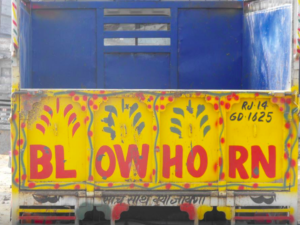 Not that any of the drivers needed urging. Blowing horns is the constant chatter of conversation among Indian drivers. Some drivers favor the short, continuous toot, others prefer the long uninterrupted blast. Together, the cacophony resembles an especially discordant orchestra warm-up session. And if there are no other vehicles on the road? Your driver will blow the horn to break the silence.
Traffic—well, surviving traffic—is one of the most exciting adventures for any visitor to India. It’s an adventure you can’t avoid, unless you’re willing to board a tourist bus (don’t even think of riding a local bus). And you don’t know tedium until you’ve been trapped in a tourist bus within tantalizing sight of your destination, realizing your bulky bus will be the last vehicle to make it through the traffic funnel ahead.
The wonderful thing about traffic in India is the rules of the road are flexible–open for interpretation, you might say. Traffic lights, especially red lights, are more suggestions than strict instructions. Lane markings are guidelines. A two- or three-lane highway, for example, easily accommodates up to four more lanes, particularly when there are sidewalks or flat shoulders to use as passing lanes.
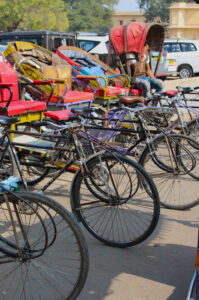 You need a car and driver for longer distances. But for efficiency, you can’t beat the tuk-tuks. They’re designed for a driver and two, maybe three, passengers, and seem to be the favored transport of sari-wrapped women and small families. Tuk-tuks range from decrepit to possibly having been built in the current decade. They, too, are painted with the ubiquitous “Blown Horn” edict. They have mileage meters. Ignore them, they aren’t relevant. Fares are negotiable. Settle the price before stepping inside. I usually ask someone what the fare should be, then count on paying up to double that amount. The rides are cheap, I’m a Westerner and I don’t speak Hindi—the extra rupees are a tourist’s premium.
Be forewarned. Foreigners are highly desirable passengers. Step into the street, and you’re like a bread crust attracting crows. Find a driver you like and book him for the following day. It’s a self-preservation tactic. For one thing, every tuk-tuk driver wants to take you shopping. Doesn’t matter where you’re actually going, they will first take you shopping.
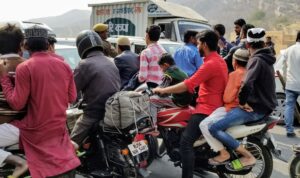 Have I mentioned the motorcycles?
Typically, there are one or two passengers on a cycle, often a woman sitting sidesaddle, a hand lightly on her husband’s shoulder, while the tail of her saree flutters dangerously close to the wheels. There may be a 20-pound sack of rice wedged between them, or a child or two tucked in here and there.
Bikes, bicycle rickshaws and human-pulled freight wagons jostle for what space remains. When possible, they go with the traffic flow. If not—well, rules are flexible.
Bravest and boldest of all are pedestrians. Crossing a street on foot in Jaipur requires a steely willingness to walk into traffic without meeting the eyes of on-coming drivers.
If traffic is its own elemental force in India, it is also a spectacle.
Eventually, we reached Amber Palace. The return trip was even more arduous, but not without its own spectacle—a painted elephant, on its way home from work.

Susan Caba’s first road trip was as an infant, from Fairbanks, Alaska, through the Yukon to Denver. She is a former reporter for the Philadelphia Inquirer and lives in Santa Barbara.

 These past two years, since my divorce, I was able to convince the family to let me decorate the tree with a color palette base of silver and white with one other color for effect. And the trees have looked amazing! Last year, we went with red as the focal color, and this year’s tree we did in blue. Blue always felt more Christmas for me since winter feels like a blue color for some reason to me.
 is seeing various types of Christmas tree decorations pop up on my social media feeds. I love thematic tress, probably a remnant from my years as a teacher. Trees with dessert themes are too cute, and there’s even a Darth Vader tree that I totally thought would be fun to do. I really considered doing something like that, but it requires a strategic search and purchase of thematic ornaments, so I will need to wait on that idea.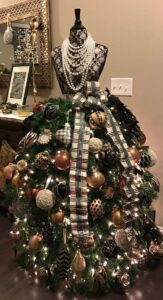



 It is an exhausting time not only because of the sales push, but because end of year inventory and financials must be gathered before, hopefully, we can all take a much needed two week break. That’s the goal. And each year that Inklings Publishing has been in business (eight total so far), we have closed our doors and refused to let any of our people work the last two weeks of December. Not until the first Monday after the New Year do we return to work. It’s important to me that my staff, and me, take time to rest and enjoy our families.
 But this day, on Thanksgiving, it is a good moment to stop and fill our minds with hope. To remember that during all of the difficult times, alongside the negative, there are always shinning moments of light. As I think about this year, I see that on the pathway through the rough time there have been amazing people who have shown love and support, moments of joy and happiness, along with a renewed sense of purpose.
 One of the coolest things I’m thankful for from this year is the review my book, United Vidden, received from Dr. Who Online. The official site of the Dr. Who fandom follows me on Twitter and saw me post the cover of my book. They liked it and had one of their reviewers read it. Nathan Jones posted his glowing recommendation of my novel in July on the site’s review page. I’m still thrilled to have received the high praise.
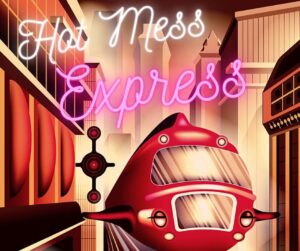 My new podcast, The Hot Mess Express, has launched this year. It has taken off in a strong following of cool participants. My co-host, Aimee Ravichandran, and I share the behind the scenes madness of our lives. The social media platforms are filled with posts of perfection and how successful everyone is. This creates the feeling that everyone else’s life is worry free and fantastic, while our own lacks luster. Our goal is to show that you can make your life a success in spite of the hot mess around you. Aimee and I are a hot mess, yet we are making our life work.
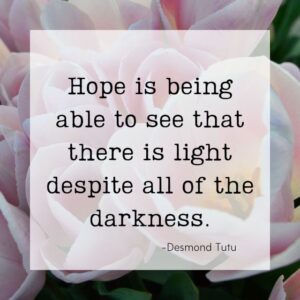 In the end, as I look back upon all that has happened, there really is more reason for celebration than for sadness. Ellen and I, both, hope that for you, too, this is the case. On this Thanksgiving day, take time to search out for the light and fill your mind with all the good things that have happened. These will sustain us as we keep moving forward through the darkness into the next nuggets of light and success waiting for us.
 Daunting as the challenge feels, it does a couple things for you as a writer:
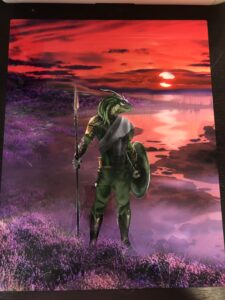 I outline what I already have on the page to find where the plot holes are that need filling. The fact that I’m starting off without an outline doesn’t worry me. What does is that I have been struggling with the section of book two that I absolutely need to finish. Worse yet, I’ve been stuck on this section for a long time. I should by now have some plan for this portion of the book, that remains basically unwritten because really the first draft just said “there’s a war, then they make peace.”
 As I reflect on this past weekend’s conference, I think about the many learning roads my life has taken. I graduated high school, and went straight into college. Being of Mexican origin, I had the blessing of deciding between two cultural traditions. I could do the American method by heading off to a distant university, living in dorms/or off campus apartments, and getting the full college Americana experience.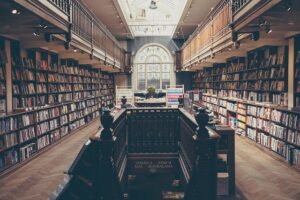
 Which brings me to the learning roads of the pandemic years (yes because we are now nearing year two of the era of human history). Thanks to Zoom and virtual platforms, I’ve been able to delve deeper into my writing than ever before. I’ve learned so much through writers retreats and workshops hosted by Max, and, perhaps more importantly, I’ve stayed connected to other writers during the times of isolation and quarantines. This has been huge benefit. I have not felt as lonely or depressed as I think I may have been if these avenues of camaraderie and fellowship had not bee available to me.

 Marketing your books, finding reviewers and bloggers to help spread the word, developing a vibrant author platform, and connecting to other formats like audio book or the filmmaking industry, are all key elements that career-minded authors need to know. So as the date for the second conference of the year drew near, the board and I focused on making it as comprehensive as we could. The Indiepalooza line-up turned out truly jam packed with amazing sessions.