

“Blow Horn.”
We were hemmed in by a pack of gaily painted and be-ribboned trucks on a busy two-lane road in Jaipur, India on our way to visit the Amber Palace. The command to “blow horn” was decoratively painted on the back of every one of the trucks, sometimes twice.
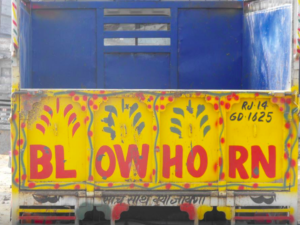 Not that any of the drivers needed urging. Blowing horns is the constant chatter of conversation among Indian drivers. Some drivers favor the short, continuous toot, others prefer the long uninterrupted blast. Together, the cacophony resembles an especially discordant orchestra warm-up session. And if there are no other vehicles on the road? Your driver will blow the horn to break the silence.
Traffic—well, surviving traffic—is one of the most exciting adventures for any visitor to India. It’s an adventure you can’t avoid, unless you’re willing to board a tourist bus (don’t even think of riding a local bus). And you don’t know tedium until you’ve been trapped in a tourist bus within tantalizing sight of your destination, realizing your bulky bus will be the last vehicle to make it through the traffic funnel ahead.
The wonderful thing about traffic in India is the rules of the road are flexible–open for interpretation, you might say. Traffic lights, especially red lights, are more suggestions than strict instructions. Lane markings are guidelines. A two- or three-lane highway, for example, easily accommodates up to four more lanes, particularly when there are sidewalks or flat shoulders to use as passing lanes.
 You need a car and driver for longer distances. But for efficiency, you can’t beat the tuk-tuks. They’re designed for a driver and two, maybe three, passengers, and seem to be the favored transport of sari-wrapped women and small families. Tuk-tuks range from decrepit to possibly having been built in the current decade. They, too, are painted with the ubiquitous “Blown Horn” edict. They have mileage meters. Ignore them, they aren’t relevant. Fares are negotiable. Settle the price before stepping inside. I usually ask someone what the fare should be, then count on paying up to double that amount. The rides are cheap, I’m a Westerner and I don’t speak Hindi—the extra rupees are a tourist’s premium.
Be forewarned. Foreigners are highly desirable passengers. Step into the street, and you’re like a bread crust attracting crows. Find a driver you like and book him for the following day. It’s a self-preservation tactic. For one thing, every tuk-tuk driver wants to take you shopping. Doesn’t matter where you’re actually going, they will first take you shopping.
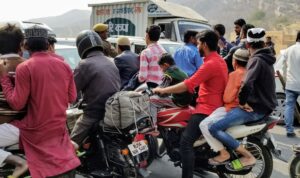 Have I mentioned the motorcycles?
Typically, there are one or two passengers on a cycle, often a woman sitting sidesaddle, a hand lightly on her husband’s shoulder, while the tail of her saree flutters dangerously close to the wheels. There may be a 20-pound sack of rice wedged between them, or a child or two tucked in here and there.
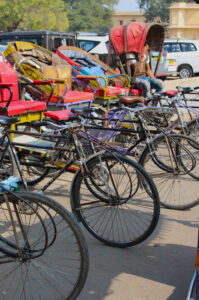
Bikes, bicycle rickshaws and human-pulled freight wagons jostle for what space remains. When possible, they go with the traffic flow. If not—well, rules are flexible.
Bravest and boldest of all are pedestrians. Crossing a street on foot in Jaipur requires a steely willingness to walk into traffic without meeting the eyes of on-coming drivers.
If traffic is its own elemental force in India, it is also a spectacle.
Eventually, we reached Amber Palace. The return trip was even more arduous, but not without its own spectacle—a painted elephant, on its way home from work.

Susan Caba’s first road trip was as an infant, from Fairbanks, Alaska, through the Yukon to Denver. She is a former reporter for the Philadelphia Inquirer and lives in Santa Barbara.