

So you might be thinking, okay Fern, I did the scheduling thing and I have this handy dandy ideal world itinerary, but now what?
 Well, now we talk about implementation. The ideal world calendar is a guide, to help you hold space for the things that are needed and those you want to pursue. It labels spaces in wide categories, like work, writing time, cooking, or real estate work, inklings work, or whatever your categories turned out to be. Those hours are reserved for those things. On a daily basis, what actually happens during those time sets can vary.
 Each Sunday, I sit with my ideal calendar and I look at my weekly planner. The first thing I do is place the things that will happen and that cannot be moved. Unlike the ideal week, here we add the more specific pieces of what we are doing for that time. So not just I’m working teaching classes at this school, but a notation on the specific lesson and the week in the program to track the progress. Not just, we have a podcast, but the specific guest we will be interviewing, or a general topic we want to at least begin with.
Now, I look at things that have come up that are not on the master plan. Like for example, lunch with a friend, or a mail run that can’t wait for the prescribed week when errands are done. You look across the week and see where the unexpected extra can go. In the week pictured here, the extras that popped up where needing to do a mail run and have lunch with James. Since I already had to be out of the house to go to Shuffleboard on Wednesday and I would be in the area of town where James could meet up and the post office I prefer is located, it made sense to put these events on Wednesday. This meant that my Wednesday writing time was cut.
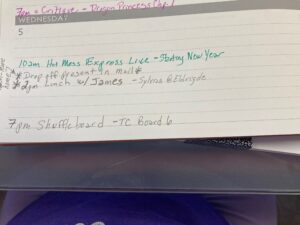 The biggest consequence of course to cutting that is in what the next writing time work will include. Normally, Wednesday is the time I implement revisions from the feedback gained during Tuesday night’s critique session. But doing that on this particular week ended up happening instead during Friday’s writing session. This made Friday a little heavier on the revision side and less time with moving new pieces forward, but how could I say no to lunch with James?
As I work to fill in the rest of the time spaces, I look at specifically what needs to b e accomplished that week. I don’t just write “Inklings work.” Instead, I itemize the specific task, like on Monday completing the draft of the HOA first quarter newsletter that we do for a specific association. As it’s the first Monday of the month, we have the Houston Writers Guild board meeting. I Don’t just write “board meeting.” I specify the overall topics needed to discuss.
The first weekend of January kicks off with a writing intensive. So I list not just the session times, but for my writing around those what I want to accomplish and in which project. You can see the specific week’s schedule in the ongoing planner v the idealized itinerary in these pictures.
By having the time labeled and specified for ideal use, it makes planning the week’s specific tasks easier. I know I have to draft the newsletter and I know exactly when that needs to be done. This helps keep things flowing.
If you did the idealized plan work from my last blog post. Try using it to formulate proactively the next few weeks. See if it helps you. Drop me a line if you want to comment or share how it went.

